🧪 I started with a simple goal: learn Splunk data onboarding properly.
6 May 2026
Originally published on LinkedIn ↗
🧪 I started with a simple goal: learn Splunk data onboarding properly.
Not just “click around Splunk Web and hope it makes sense” learning. I wanted a practical lab where I could see the full journey from data source to searchable event.
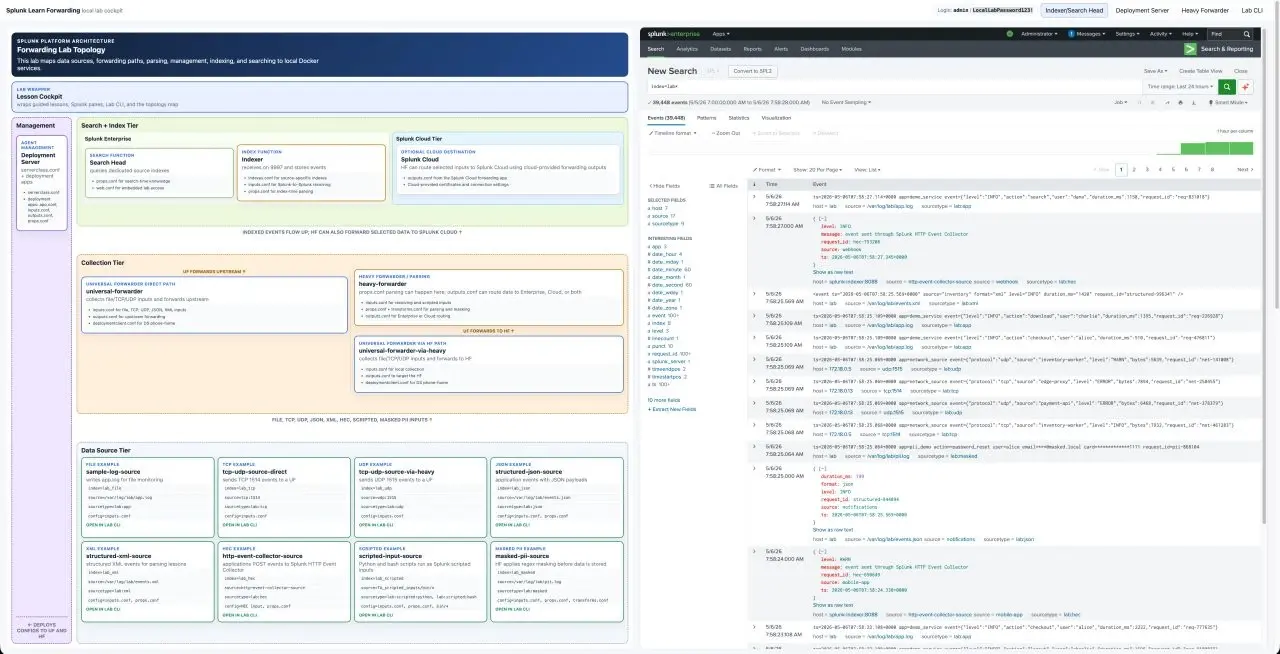
So I built a local Docker-based Splunk forwarding lab with agentic help.
It started as a basic setup: Splunk Enterprise, Deployment Server, Heavy Forwarder, Universal Forwarder, some sample logs, and a few lessons.
Then, as usual, the scope grew legs.
The lab now has: ✅ Direct UF -> Indexer forwarding ✅ UF -> HF -> Indexer forwarding ✅ File, TCP, UDP, JSON, XML, HEC, scripted, and masked PII data sources ✅ Dedicated indexes per data source type ✅ A visual topology map ✅ A Lab CLI pane that shows the actual relevant config files for each source ✅ inputs.conf, outputs.conf, props.conf, transforms.conf, serverclass.conf, and deployment apps wired into the flow ✅ Regex masking on the Heavy Forwarder before events are indexed
The most useful part wasn’t just getting it working.
It was iterating through the things that broke: embedded Splunk cookie handling, forwarders not picking up config consistently, stale HEC tokens, index routing mistakes, and figuring out where parsing actually happens.
That’s the bit I wanted from this project: not a demo, but a learning cockpit.
There’s something powerful about making infrastructure visible. When you can click a data source and immediately see the files that make it work, the mental model starts to stick.
Still rough around the edges, but it’s becoming exactly the kind of hands-on lab that suits my learning style.
Next phase is to merge this into my existing Splunk lab that you can see here https://lnkd.in/gbFJh8eZ
#Splunk #Observability #SplunkPartners #LearningByBuilding #cursor #gpt5.5