"What are my agents doing, with who, when?"
15 May 2026
Originally published on LinkedIn ↗
"What are my agents doing, with who, when?"
I couldn't answer that cleanly yesterday. Today I can.
Yesterday I posted about FamilyOS — every AI agent in my house operates under a binding contract with a defined identity, mandate, and tool scope. Solid governance on paper.
But governance without visibility is just markdown. So today I shipped the visibility layer, running on the same Splunk instance that already powers the rest of my homelab.
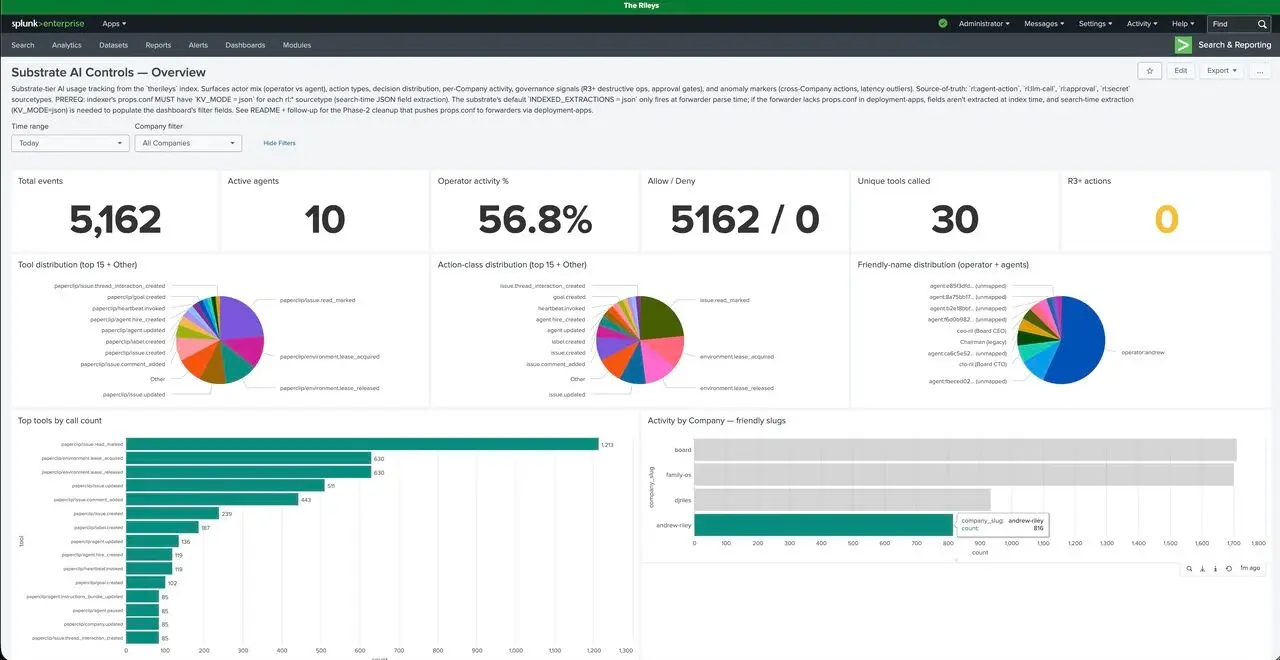
Every agent action now lands in a single live view: which agent fired, which tool it called, who it interacted with (a human, a system, another agent), what changed, and when. The same audit trail that proves governance is the feed that drives the operational dashboard.
The first full day on: - 5,162 agent actions logged - 10 active agents, 30 unique tools called - 5,162 allowed, 0 denied — every action conformed to its contract - Operator-driven activity sitting around 57%
It maps onto the four pillars Splunk wrote up for AI Agent Monitoring in Observability Cloud — performance, cost, quality, reliability. Same shape as enterprise observability, much smaller scale.
Worth a read if you're thinking about this at any scale: https://lnkd.in/gqEhZYu4
The honest takeaway: I should have built this on day one. Operating blind cost me more time than instrumenting properly ever would have.
If you're running multi-agent systems, what's your visibility layer? Logging, tracing, eyeballing, or hoping?
#AIAgents #Observability #Splunk